Skip to content
A lot of people only realise they bought the wrong compressor after they start using it.
The nail gun does not sink nails properly, recovery feels slow, and the whole setup starts to feel a bit average. In plenty of cases, the tool is not the issue at all. The compressor is just too small for the job.
The opposite happens too. Some people assume bigger must be better and spend more than they need to for the kind of work they are actually doing.
The right air compressor depends on the nail gun, how often you are firing, and whether the work is light and stop-start or heavier and more constant. Get that part right and the whole setup is easier to live with.
If you are using a pneumatic nail gun, yes.
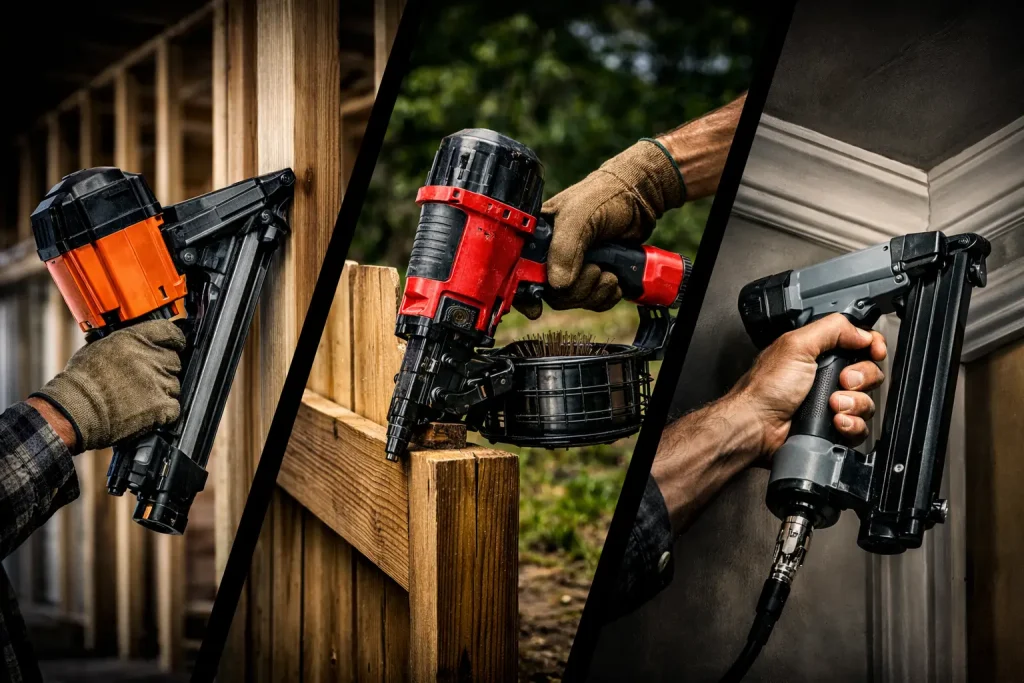
Pneumatic nailers rely on compressed air to fire properly. That includes a lot of brad nailers, finish nailers, framing nailers, coil nailers, and many staplers as well.
If you are using a gas nailer or a battery-powered cordless model, that is different. Those do not need a compressor. This guide is about air-powered nail guns and staplers.
PSI is the pressure the tool needs to operate properly.
If the pressure is too low, the nail gun may not sink nails cleanly. If it is too high, you can create wear and inconsistent performance. Most pneumatic tools have a working pressure range, so the compressor needs to sit comfortably within that.
CFM is the airflow the compressor can deliver.
This is where a lot of setups fall short. A nail gun might technically fire on a small compressor, but if the airflow is not there once the pace picks up, recovery gets slower and performance becomes patchy.
Tank size affects how much stored air you have before the compressor has to cycle again.
A small tank can still work well for lighter jobs. It just gives you less breathing room. That becomes more noticeable when you are working faster or using tools with higher air demand.
For brad nailers and a lot of finish nailers, a smaller portable compressor is often enough.
That is especially true for trim, joinery, skirtings, cabinetry, and other lighter stop-start work. These tools usually do not place the same demand on the compressor as a framing nailer or other heavier-duty setup.
For many users, a compact compressor makes good sense here. It is easier to move around, easier to store, and often more than capable if the tool’s pressure and airflow requirements are covered.
Where people run into trouble is assuming that because it works for a few shots, it will stay comfortable all day. That depends on how hard you are pushing it.
If you are mainly doing trim, joinery, or cabinetry work, have a look at our brad nailers to see the kind of tools usually matched with smaller compressor setups.
A framing nailer usually asks more of the compressor.
If you are working with larger timber, firing more regularly, or using the tool for structural work, you will normally want more airflow and more reserve than you would for a lighter trim gun.
This is where smaller compressors can become annoying. They may still fire the tool, but once the pace lifts, you can run into slower recovery, inconsistent drive depth, and more cycling than you want.
If the work is heavier and more repetitive, it usually pays to size up rather than try to get by on the minimum.
→ See our Pneumatic Nailer range
Sometimes, yes. Sometimes not even close.
A small portable compressor is often a good fit for:
brad nailers
finish nailers
light-duty staplers
smaller workshop jobs
mobile or occasional use
It is less ideal for:
framing nailers
coil nailers
repeated heavy firing
larger site work
running more than one pneumatic tool
That is why the better question is not just whether the compressor can run the tool. It is whether it can run it well enough for the way you work.
The same logic applies to air staplers too.
A light or medium-duty stapler used now and then may be perfectly fine on a smaller compressor. A heavier-duty stapler being used more aggressively may need more airflow and more headroom.
If you are planning to run multiple pneumatic tools in the same space, it makes more sense to size the compressor around the heaviest demand rather than the lightest tool in the shed.
{Insert internal link to Air Staplers}
This is where people often start blaming the tool.
If the compressor is undersized, you can end up with:
poor drive depth
weak or inconsistent firing
slow recovery between shots
constant cycling
more frustration than there needs to be
Sometimes nothing is actually wrong with the nail gun. The air supply behind it just is not keeping up.
That does not mean you need the biggest compressor on the market. It just means the setup needs to match the job properly.
If you want the short version, this is the safest way to think about it:
Bullet Points:
Brad nailers and finish nailers can often run well on a smaller portable compressor
Framing nailers and heavier-use tools usually need more airflow and reserve
Longer runs of work usually justify sizing up
Always check the tool’s pressure and airflow requirements before buying
Leave some headroom instead of buying right on the edge of the minimum
A setup that just scrapes over the line on paper often becomes a pain in real use.
If you are not sure what compressor suits your nail gun, stapler, or the kind of work you are doing, it is worth getting proper advice before you buy.
At Air Gun Services, we can help you match the compressor to the tool, the job, and the way you actually plan to use it. That means less guesswork, fewer compatibility issues, and a setup that makes sense from the start. Call 09 525 6548 or email us at office@airgunservices.co.nz
If you are still working out which type of tool suits the job, our guide to choosing the right nail gun is a good place to start.
 Optimized by Seraphinite Accelerator