Skip to content
Ask ten people about nail guns and you will hear ten different answers. The disagreement rarely comes from brand loyalty. It usually comes from people using tools outside their intended role.
Most buying mistakes start before anyone even looks at specifications. They begin with a simple assumption that a nail gun is a general purpose tool. It is not. Nailers are designed around very specific fastener types, material densities, and workloads. When those factors do not line up, problems show up quickly on site.
Buyers often approach the decision backwards. They compare models, features, and prices before clarifying what the tool will actually be used for. This is how someone ends up trying to frame with a finish nailer or expecting a brad nailer to handle structural tasks.
The label “nail gun” hides the reality that different tool classes solve very different problems. A tool that performs cleanly for trim work may struggle badly in framing timber. A nailer that drives large nails effortlessly may be completely unsuitable for delicate finishing jobs.
A more reliable approach is to start with the fastening task itself. Consider the material, the size of the fastener required, and how much holding strength the joint needs.
Framing nailers are built for load bearing connections. They drive larger nails designed to secure structural timber where strength matters more than cosmetic finish. These tools operate at pressures suited for dense material and repetitive heavy use.
Using lighter nailers in this role is a common and expensive mistake. Smaller gauge nails may hold temporarily but lack the grip required for structural reliability. Misfires and inconsistent driving depth are also more likely when a tool is pushed beyond its design limits.
Finish nailers exist for a different purpose. They handle smaller nails intended for skirting boards, architraves, mouldings, and interior trims where surface appearance matters. These nailers are designed for controlled fastening and reduced marking rather than brute holding force.
They are not substitutes for framing tools. Expecting them to perform structural duties often results in weak joints or damaged workpieces.
Brad nailers are optimised for precision and minimal material disturbance. Cabinetry, light trims, and fine joinery are their natural territory. The smaller fasteners reduce splitting and leave cleaner results, but holding strength is limited.
Problems arise when users expect them to behave like heavier nailers. The tool itself is not underperforming. It is simply being asked to do the wrong job.
Two patterns appear repeatedly in workshops and repair benches.
Over-specifying leads to heavier tools, higher air demand, and unnecessary fatigue. Under specifying leads to tools that struggle, cycle inconsistently, or fail early under workload. In both cases, the mismatch reduces efficiency rather than improving it.
Fastener compatibility is another frequent issue. Nailers are engineered around particular nail types and angles. Subtle differences between fasteners can affect feeding reliability and driving performance. Jamming, misfiring, and surface marking often trace back to incorrect consumables rather than tool faults.
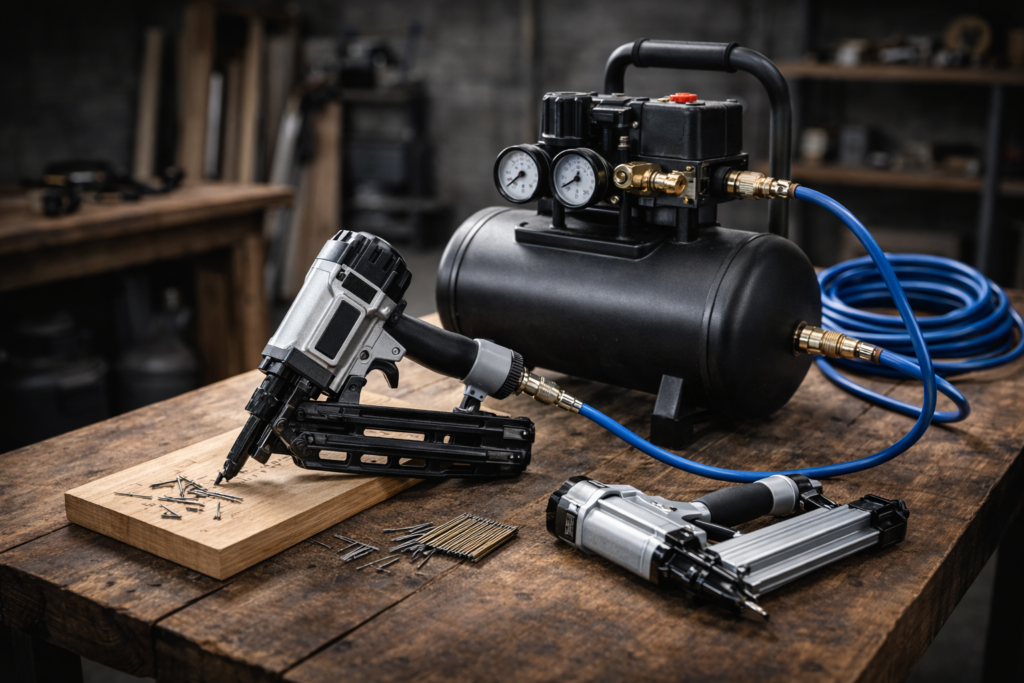
Performance complaints are frequently blamed on the nail gun when the air system is the real constraint. Pneumatic nailers depend on stable pressure and sufficient airflow. An undersized compressor or inconsistent pressure delivery produces erratic results regardless of tool quality.
Driving depth issues, slow cycling, and apparent misfires can often be traced to air supply limitations. Matching the nailer to the compressor is not a technical afterthought. It is fundamental to reliable operation.
Fastener selection carries similar weight. Nail size, coating, and collation style all influence how the tool behaves in real materials. Correct pairings tend to work smoothly. Incorrect pairings tend to create avoidable frustration.
Sound nail gun selection is less about chasing features and more about aligning the tool with the fastening demands of the work. When fastener size, material density, and workload match the tool’s intended role, reliability follows naturally.
Most persistent problems seen in trade environments are not random defects. They are predictable outcomes of tool mismatch, incorrect fasteners, or unsuitable air setups. A small amount of clarity at purchase stage prevents a large amount of downtime later.
If you are still unsure which nail gun suits your work, the simplest option is to talk it through with someone who deals with these tools every day. Air Gun Services regularly helps tradies and workshop users avoid costly mismatches and premature tool failures. Call today.
 Optimized by Seraphinite Accelerator